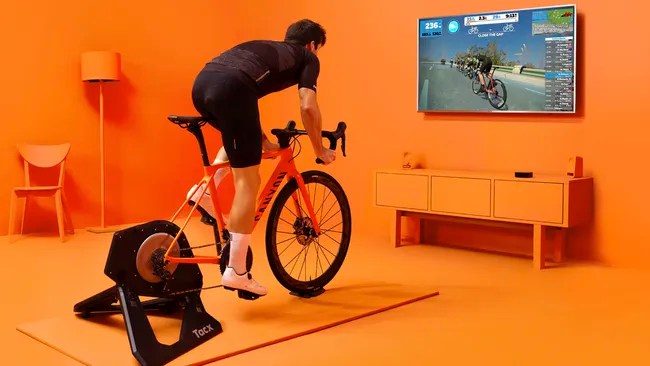
Riding throughout the winter is a great way to build fitness, stave off boredom, and connect with others. With the advent of Zwift, TrainerRoad, MyWoosh, and many other platforms, there’s something that will help you meet your goals, whatever they are.
Equipment
It’s easy to start researching equipment and head down a rabbit hole where you’re looking at a pro Zwift racer setup and get overwhelmed. The good news is it’s easy to start small and build up over time as you spend more, or less, time on the trainer. But it all starts with the trainer. A “smart trainer” can measure your power output and transmit that to the platform. The platform can in turn send signals to the trainer to increase or decrease resistance, making it easier or harder to pedal.
Wheel On Trainers
A wheel on trainer is on the more basic side but has a lot of upsides to their more expensive counterparts.
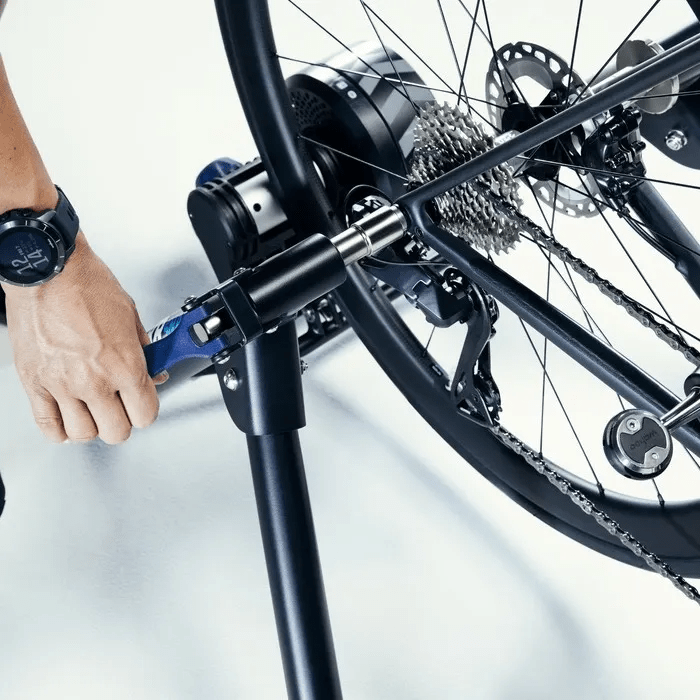
As you can see, the wheel is in contact with a roller that spins and measures power. A flywheel (to the right of the roller) provides resistance and can be controlled by your training platform for either specific interval power or realistic road feel.
Pros: This style of trainer is really easy to setup because it’s relatively light weight and can fold up and be stored easily. It’s highly functional and works perfectly with whatever platform you choose. Finally, it’s cheap. A good wheel on trainer like the Wahoo Kickr Snap will run you $300 + shipping.
Cons: Can be very loud due to the wheel rotating against the trainer roller. Not as accurate as some other trainers, generally +/- 3% is standard for this type, whereas more expensive trainers can get to +/- 1%. Can chew through tires relatively quickly, again because of the tire making contact with the trainer roller. You can buy a specific trainer tire which is made out of a much harder compound and will wear longer. Finally, you have to check tire pressure and calibrate the trainer fairly often to make sure that your data is as accurate as possible.
Direct Drive Trainers
Like the name suggests, with a direct drive trainer you drive the trainer directly. The trainer acts like a rear wheel, and the bike is mounted directly.
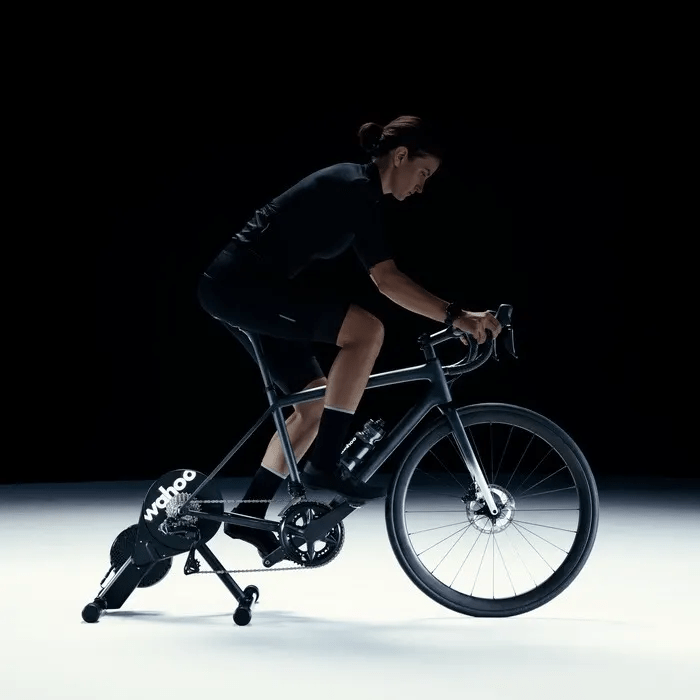
The the rear wheel is fixed to the trainer axle which turns a flywheel via a belt, and measures your power output and provides resistance just like a wheel on trainer.
Pros: Quieter, more accurate, no additional equipment (trainer tire or additional tires when they wear out. Exception being some direct drive trainers don’t include a cassette, so there is that one time purchase), calibration is slightly easier.
Cons: Heavy (due to the larger flywheel) and can be a hassle to move. More expensive, the Wahoo Kickr Snap will run you $500.
Thoughts
If you spend any serious amount of time on the trainer over the winter, you’ll likely find yourself on a wheel off trainer at some point. The convenience, accuracy, and ‘set it and forget it’ nature make it very appealing.
That said a wheel on trainer is an excellent option, and there are very few reasons where a direct drive is superior beyond personal preference.
Either way, there are plenty of deals to be had on used trainers and for in depth comparisons DC Rainmaker is the best in the business.
Platform
Zwift is the defacto platform for social riding, racing, and dipping your feet into structured training. There are other options out there but they’re more specific and if they’re for you, you won’t need me to tell you about them. So for now, Zwift is my recommendation for anybody looking to do some riding over the winter.
Bike Radar has an excellent guide to everything Zwift that covers getting started, the different worlds and courses, available group rides, racing, workouts, and more. I’ll cover some of the fun events, clubs, and racing in more detail.
Events
Organized events are the highlight of Zwift. There are group rides that range from casual to all out hammerfests, group workouts, fondos, races, and more. The events page on the Companion App is a great resource to filter and see what’s out there.
Group Rides
Fondos
Organized fondos are a great way to dip your toe into racing and the social scene on Zwift. You’ll be riding in mixed categories with some riders looking to race and some looking for a more social experience. As a result you can smash yourself holding onto the front group, and if and when you’ve had enough you can drop back into a group to see out the rest of the ride. There are a number of events that are hosted by community groups and Zwift organizes a number of events every year that are worth attending.
The Tour de Zwift is an annual 8 day stage event with varying stage lengths, riders can choose from a number of different course lengths and difficulties. For completing all the stages riders receive themed in game kit.
Around the holidays the Zwift Fondo Series occurs with three separately themed events, in 2024 it was the Feast, Holiday, and New Year’s fondos, each with three different lengths. As with the Tour de Zwift, there are special kit unlocks and some fun course changes during the events.
Finally a newer one that spans multiple months is the L’Etape du Tour De France which spans 4 months, with two rides a month, a prologue and longer route. This one blurs the line between a fondo and race with riders’ overall times being calculated and a General Classification being tracked for each month and the overall!
Racing
There are also a number of race series available to scratch that competitive itch. The racing (and events in general) are broken down into categories. There are two types of categorization systems on Zwift. One is Watts per Kilogram based:
- A = 4.0w/kg and above
- B = 3.2–3.9w/kg
- C = 2.5–3.1w/kg
- D = 2.4w/kg and below
The other is a newer system called Zwift Racing Score, which is based off race performances and power profile from those races to give a score.
The racing comes in a number of different types depending on what and who you want to race with. There is a lot of good ‘open racing’ on Zwift, 3R has lots of races, as well as Zwift Insider’s Tiny Race Series, which are a great introduction. These races you sign up for through the Companion App, and don’t need a team to compete in, but you can bring some of your friends along (and I recommend it).
The highly competitive racing is done via signups outside of Zwift, like Zwift Racing League (ZRL), Flamme Rouge Racing (FRR), and Club Ladder. These races generally have more rules and regulations to ensure fair racing,
ZRL pits teams of 5 riders against each other over six weeks with three different formats, each raced twice. At the end of the season there is a promotion & relegation between the divisions. There are three seasons which setup for the ZRL Finals where your team competes for in game kit!
FRR run stage races that vary between eight and eleven stages that span over two weekends with a rest day. They mimic a World Tour stage race with competitions for overall points, KoM, team, and general classification. They run a custom category system that operates similarly to the Zwift Racing Score. They offer multiple time slots for each stage.
Club Ladder is simple. Two teams, five riders each, lower ranked team submits a challenge and a course. 10 points for first place, 9 for second, and so on. Winner takes the spot on the ladder and the loser moves down. This format is a lot of fun, low stakes, and makes for really hard racing!
The best way to get involved with this racing is to join one of the many communities out there. Some racing requires a team, and all the racing is more fun with a team! Teams are always looking for new riders and are all very welcoming.
Workouts
Structured workouts are the best way to get faster, period. Zwift has a solid library of workouts, as well as multiweek training plans. They’re a good way to train specific types of fitness or generally build fitness over the course of the winter. These plans are a great way to dip your toe into structured training in a low commitment environment and really set yourself up for some racing or come out swinging for group ride season.
Final Thoughts
Zwift is a great way to stave off winter boredom and prepare yourself for the outdoor season. The biggest challenge to spending time on the trainer is an uncomfortable setup and not having the right entertainment. While Zwift can be very engaging, I also recommend having secondary entertainment, streaming services, podcasts, or music, to keep you company while solo riding or doing a workout.
I hope this has been a helpful overview of the wonders of indoor riding, and I hope to see you in Watopia!
 Fast But Friendly